
Investing in Talent, Advancing Discovery: Successes from Dr. Harinad Maganti’s Research Group
Thursday, November 12, 2026 Ali Shukri
At Canadian Blood Services, supporting highly qualified personnel is a vital part of advancing research and strengthening Canada's blood system. By investing in trainees through mentorship, funding opportunities, and collaborative learning environments, we help develop the next generation of researcherswho will harness new technology to accelerate advances in transfusion medicine and cellular therapies.
The impact of that investment can be seen in the recent achievements of trainees working with Dr. Harinad (Hari) Maganti, whose research is laying the foundation for the development of new hematopoietic stem cell-derived products and universal immune cell therapies, transforming the outlook for patients.
Building capacity through research
Research excellence depends on more than innovative ideas. It relies on skilled people with the knowledge, experience, and support needed to turn those ideas into discoveries that improve health outcomes.
Developing highly qualified personnel is a core part of Canadian Blood Services’ research mission. Trainees gain hands-on experience advancing research that supports Canada’s Lifeline, contributing to innovations in transfusion, transplantation and cell therapies with the potential to improve patient care nationwide. Working within a national organization, they collaborate across disciplines and institutions, building the skills leadership experience and scientific expertise needed to tackle today and tomorrow’s health challenges.
The success of trainees in Dr. Maganti's group demonstrates the value of that approach. Their achievements reflect not only individual dedication and talent, but also the importance of creating environments where early-career researchers can thrive.
Celebrating trainee achievement
Dr. Hari Maganti is a Research Scientist and Scientific Director, Cellular Therapies Research and Development at Canadian Blood Services and an Adjunct Professor at the University of Ottawa. His research focuses on stem cell biology, immunology and cellular therapies, aiming to better understand how blood-forming stem cells function and how new approaches in genetic engineering and cell therapy can improve treatments for patients. By combining leading-edge research with mentorship and training, his lab provides trainees with opportunities to contribute to discoveries that could help shape the future of cellular therapies.
This year, several members of his group received prestigious awards in recognition for their work.
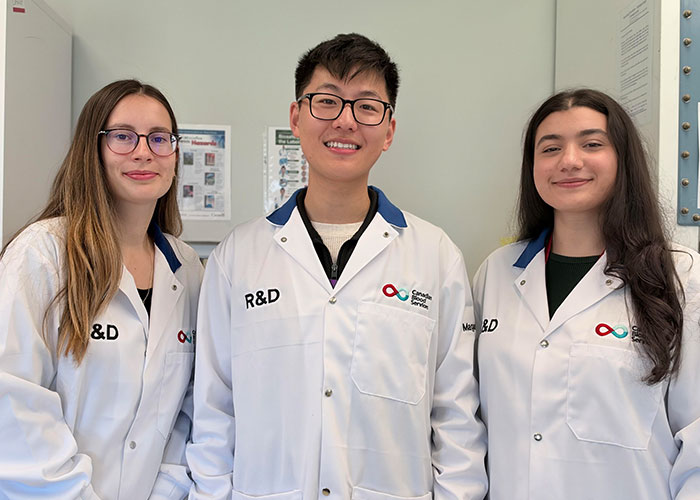
Jordan Yin recognized with CIHR Doctoral Research Award
Jordan Yin, an MD/PhD student co-supervised by Dr. Maganti and Dr. Shawn Beug from University of Ottawa, was awarded a CIHR Doctoral Research Award.
The CIHR Doctoral Research Award supports exceptional doctoral trainees whose research demonstrates scientific excellence and strong potential to contribute to health research in Canada. By investing in emerging researchers at a critical stage of their training, the award helps advance innovate discoveries and develops the next generation of leaders in health and biomedical science.
Yara Khalil receives Ontario Graduate Student (OGS) Scholarship
Yara Khalil, a PhD candidate co-supervised by Dr. Maganti and Dr. Jessie Lavoie, a scientist at Health Canada, and an Adjunct Professor at the University of Ottawa, was awarded an OGS Scholarship.
The OGS Scholarship recognizes outstanding graduate students whose academic excellence and research contributions are helping advance the future of health and biomedical research. By supporting emerging researchers, the scholarship helps develop the next generation of scientific leaders who are driving innovation and overall outcome for donors, patients, and healthcare systems.
Justine Hanotaux brings research beyond the lab
Justine Hanotaux, who is co-supervised by Dr. David Allan from the Ottawa Hospital Research Institute and Dr. Maganti, and supported through the Canadian Blood Services Graduate Fellowship Program, recently awarded the ASH Abstract Achievement Award. Justine’s abstract was selected for an oral presentation at the 2026 American Society of Hematology (ASH) Annual Meeting, happening in December.
This annual meeting is the premier global event for advancing hematology research and science, clinical practice, education, and community. Justine also previously presented at the Cell Therapy Transplant Canada (CTTC) annual conference this past May and received an award for her oral presentation.
Our Graduate Fellowship Program helps develop the next generation of transfusion and transplantation researchers by providing competitive funding, research support, and professional development opportunities. Through hands-on research experience and mentorship from leading scientists, individuals gain the skills and expertise needed to translate discovery into meaningful improvements for donors, patients, and the healthcare system.
Looking ahead
The future of transfusion science depends on the people who will carry the field forward.
By supporting highly qualified personnel, Canadian Blood Services is helping build the expertise, innovation, and leadership needed to address tomorrow's health challenges. The achievements of trainees in Dr. Maganti's group are a reminder that investing in people is one of the most important ways to advance research excellence.
As these researchers continue their scientific journeys, they are contributing not only to today's discoveries, but also to the future strength and sustainability of Canada's research community.
Canadian Blood Services – Driving world-class innovation
Through discovery, development and applied research, Canadian Blood Services drives world-class innovation in blood transfusion, cellular therapy and transplantation—bringing clarity and insight to an increasingly complex healthcare future. Our dedicated research team and extended network of partners engage in exploratory and applied research to create new knowledge, inform and enhance best practices, contribute to the development of new services and technologies, and build capacity through training and collaboration. Find out more about our research impact.
The opinions reflected in this post are those of the author and do not necessarily reflect the opinions of Canadian Blood Services nor do they reflect the views of Health Canada or any other funding agency.
Related blog posts

Monday, June 15, 2026
Abby Wolfe
On May 16, 2026, Canadian Blood Services’ Ottawa site welcomed members of the Sickle Cell Awareness Group of Ontario (SCAGO) and the SCAGO Youth Empowerment Program for a special Sickle Cell Science Expo event. This blog offers a recap of some of the events’ activities and learnings.

Thursday, June 13, 2024
Tricia Abe
A new kind of proposed treatment for sickle cell disease—one that removes the need for a compatible donor—is being studied by Dr. Harinad Maganti, a scientist at Canadian Blood Services.

Friday, July 24, 2026
Renee Horton
July is Cord Blood Awareness Month, and this blog describes how research led by members of Canadian Blood Services' research team are using cutting-edge science to turn cord blood stem cells into life-changing treatments for diseases like cancer, sickle cell disease, and more.